01
Diagnose
Establish the current state, identify the real constraint, and determine what needs to be understood before action is taken.

Proprietary Tools
Ambryze works through three stages:
Clarify the situation, surface what matters, and frame the right questions.
Translate strategic direction into practical actions, tools, and execution.
Refine performance, strengthen decision-making, and improve outcomes.
Ambryze’s proprietary tools are developed in-house and adapted to the needs of each engagement — creating structure around complex questions and helping move the work from analysis into action.
Explore the toolsHow the tools work
Ambryze develops proprietary tools to bring greater structure, consistency, and decision discipline into engagements. They are not applied as fixed templates — the methodology remains consistent while the application is adapted to the business, the problem, and the available evidence.
The current toolset is concentrated particularly around AI Transformation, where rapidly evolving technology creates a greater need for rigorous evaluation, implementation, and measurement. The same operating philosophy also informs Commercial Growth work.
Establish the current state, identify the real constraint, and determine what needs to be understood before action is taken.
Translate the diagnosis into practical decisions, operating approaches, and actions that can be applied inside the business.
Evaluate what changed, refine the approach, and strengthen performance as evidence and operating conditions evolve.
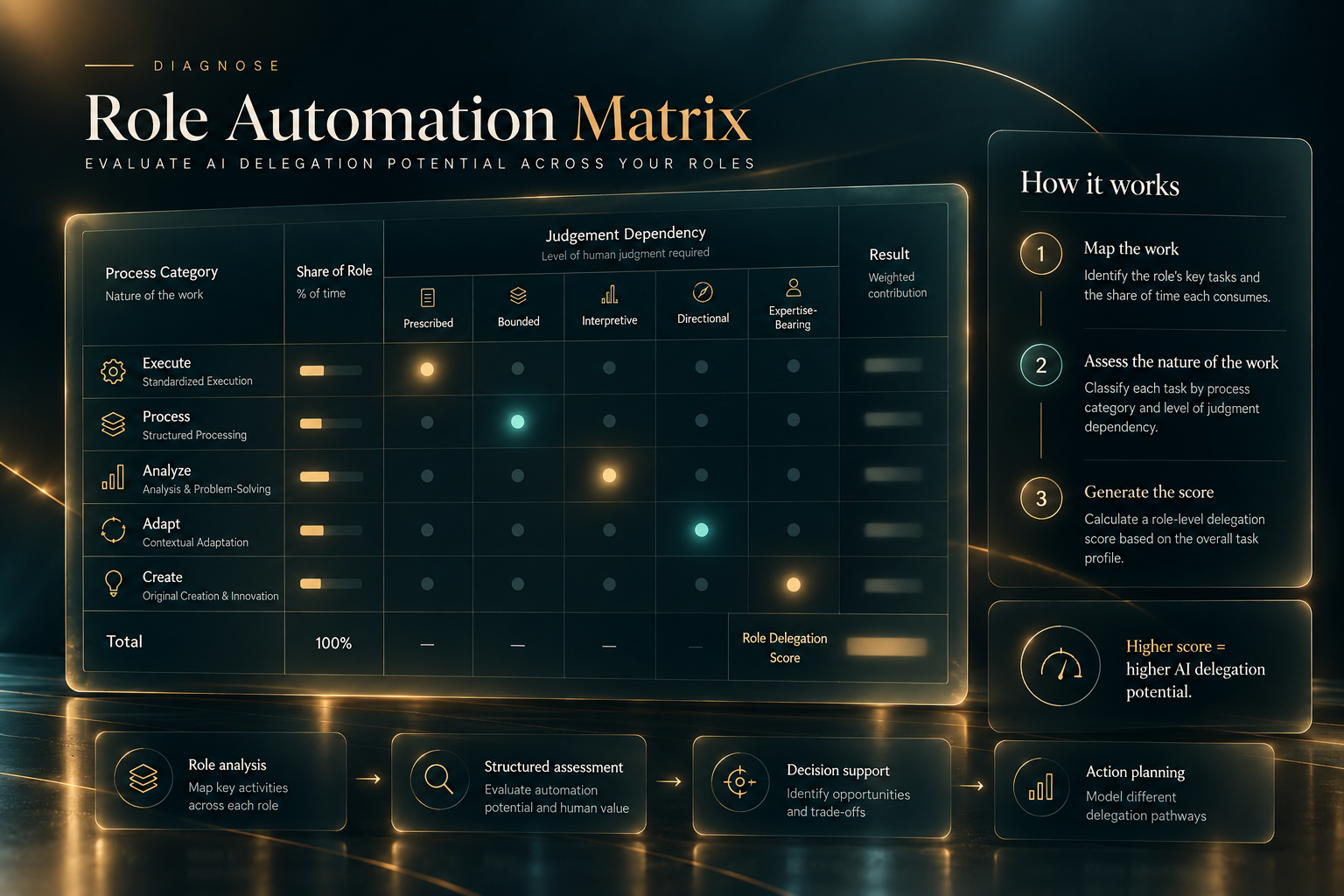
Diagnose · Proprietary Tool
The framework evaluates delegation potential — not the transfer of human accountability.
AI automation decisions are rarely binary. The question is not simply whether a role can use AI, but where technology can absorb work — and where human judgment creates essential value.
The Role Automation Matrix gives Ambryze a structured way to assess that balance during Diagnose. It surfaces where delegation, augmentation, or continued human ownership may be most appropriate, creating a clearer foundation for role redesign and implementation planning.
© 2026 Ambryze. Proprietary framework. All rights reserved. Shown for illustrative purposes only.
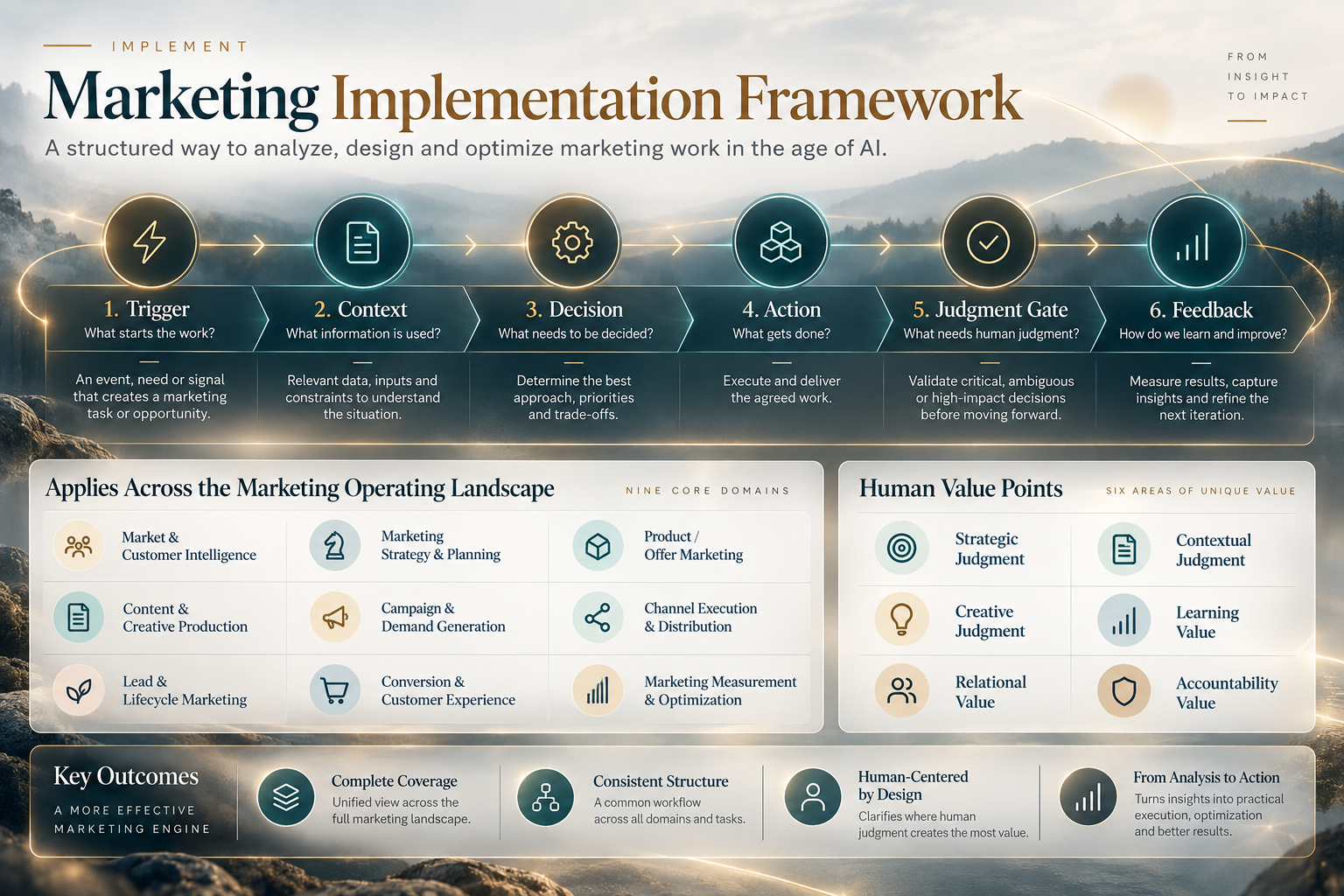
Implement · Proprietary Tool
Structure the workflow first — then decide where AI, systems, and human judgment should do the work.
AI transformation becomes useful only when it changes how work actually gets done. The framework gives Ambryze a common operating architecture for redesigning marketing workflows from trigger through feedback.
Used during Implement, it applies a consistent workflow across the marketing operating landscape, identifies where human participation creates material value, and translates diagnosis into practical choices about AI, systems, and human ownership.
© 2026 Ambryze. Proprietary framework. All rights reserved. Shown for illustrative purposes only.
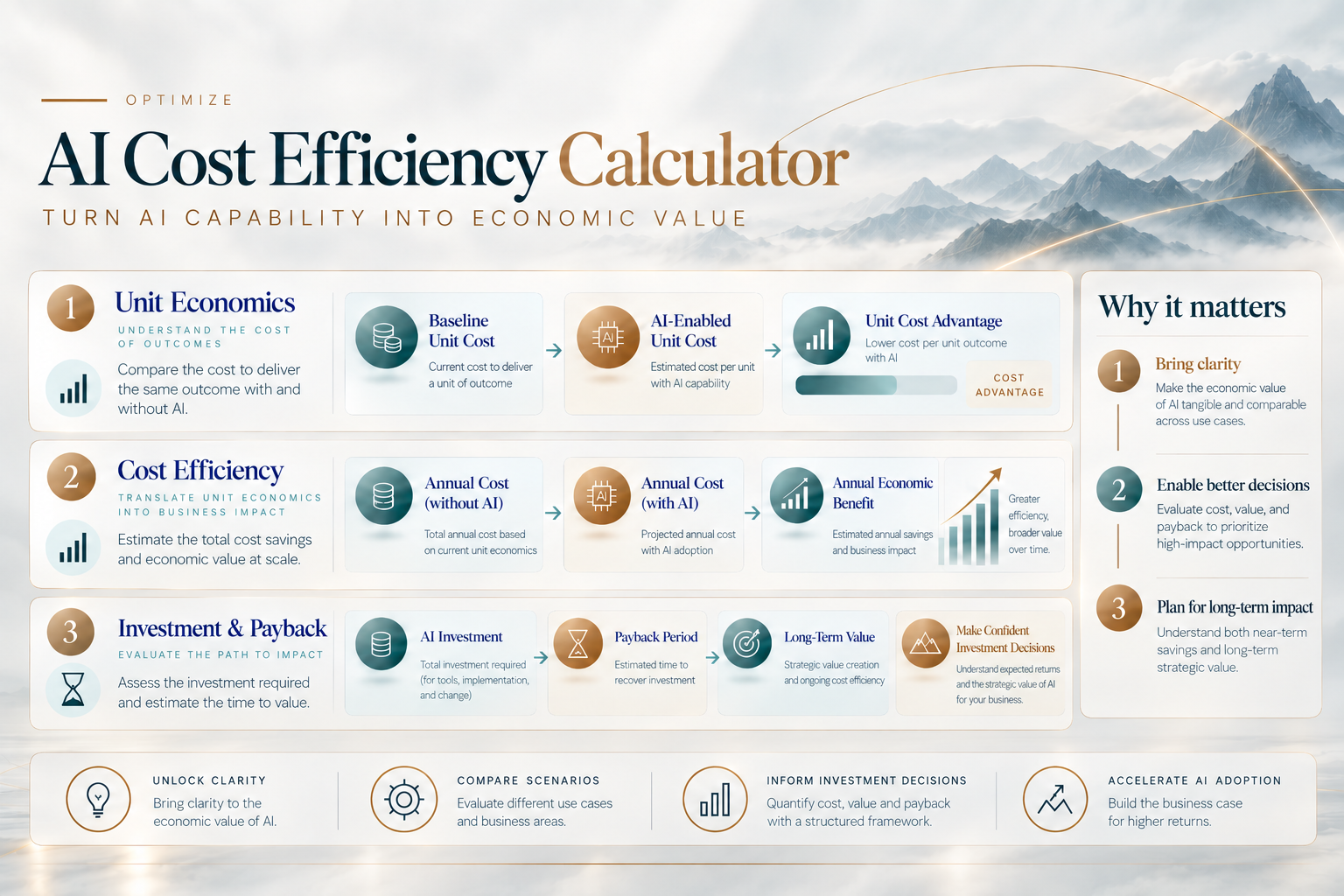
Optimize · Proprietary Tool
Model the cost of the workload — not the price of the model.
AI economics extend far beyond the price of a model or software subscription. The real question is whether AI changes the cost of delivering an equivalent business outcome in a meaningful way.
Used during Optimize, the AI Cost Efficiency Calculator evaluates recurring use-case economics, shared AI expenditure, and investment requirements — helping distinguish capacity value from cashable savings and identify where economic value survives the full cost of adoption.
© 2026 Ambryze. Proprietary methodology. All rights reserved. Shown for illustrative purposes only.